Publish time:
2021-10-19
 Clicks: 33
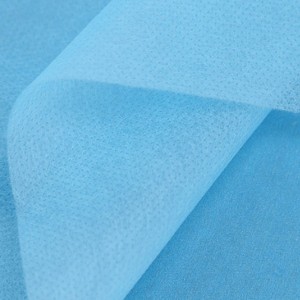
Non-woven fabric (also known as non-textile fabric) refers to a kind of fiber non-woven sheet material that is obtained by arranging or spraying formed fibers onto a base surface, and then undergoing different forms of curing and shaping. Non-woven fabric has the advantages of low cost and wide application. Today, Duome Non-woven Fabric Factory will introduce you to the three major processing techniques of non-woven fabric.
1. Spinning Fusion Method
The spinning fusion method (spinning fusion) is the most widely used one-step spinning forming process for non-woven fabric. The non-woven fabric made by the spinning fusion method uses continuous long fiber formation. The production line speed is high, and the product strength is high, as well as good dimensional stability. However, the loftiness is low, and the uniformity of the net formation and surface coverage are slightly worse.
The spinning fusion method combines the fiber spinning technology and non-woven forming technology. It utilizes the principle of melt spinning, and the raw materials are melted and mixed in the extruder, then extruded from the spinneret of the spinner head to form a melt stream. High-speed cooling air is used to cool the extruded melt stream, and at the same time, the fibers are subjected to stretching airflow during the cooling process, forming stronger and more stable continuous long fibers. The long fibers undergo the separation process to form a uniformly distributed single fiber structure, which is then laid on a negative pressure net curtain to form a non-woven fiber net. The fiber net then undergoes subsequent reinforcement devices, such as hot rolling reinforcement, needle punching reinforcement, or water jet reinforcement and setting treatment, and is wound up by the winding device to obtain the product. The key steps are melt spinning, initial fiber airflow stretching, fiber net formation, and fiber net shaping.

II. Melt Blowing Method
Melt blowing (melt-blowing) is a process where the molten material extruded by a screw is blown by a high-speed and high-temperature gas stream, causing the molten stream to be stretched at a high rate and forming ultra-fine short fibers. These fibers are then deposited onto a condensing curtain or a forming roller to form a continuous short fiber web. This web is then subjected to self-adhesion or other reinforcement processes to produce non-woven fabric.
The processing of non-woven fabric using the melt blowing method also employs the method of melt spinning, where a molten stream is extruded from a spinneret to form fibers. However, the difference from the spunbonding method lies in that the spinneret head used in the melt blowing method has specially designed air ducts (air gaps) on both sides of the spinneret holes. The heated high-pressure air is blown out from these air ducts to rapidly stretch the molten stream, causing it to be blown into ultra-fine short fibers. After the ultra-fine short fibers are cooled by the cold air below the spinneret head, they are sprayed at a high rate onto a negative-pressure fiber collection device, mainly a condensing curtain or a forming roller, to form a fiber web. Finally, through self-adhesion or other fixation methods, the formed non-woven fabric is obtained.
III. Composite Method
To overcome the shortcomings of low strength and poor dimensional stability of non-woven fabric produced by melt blowing method, the American company Kimberlley developed a composite non-woven fabric production process consisting of two or more melt blowing machines and spunbonding machines earlier. The spunbonding/meltblowing composite method (SM or SMS).
The principle of the SMS composite method is to add a melt blowing non-woven fabric forming machine between two or more spunbonding non-woven fabric forming machines to form a composite production line, which is used to produce non-woven fabrics with interlayered spunbond and meltblown fibers. This process combines the advantages of high strength and good dimensional stability of filament fiber webs, as well as the advantages of high蓬松度 and good air permeability of ultra-fine short fiber webs, thus creating non-woven fabric with excellent comprehensive performance, and has been widely used in surgical gowns, filter materials, etc.
During the SMS composite method production process, on the same production line, there are two spunbonding spinnerets and one meltblowing die head. The first spunbonding spinneret first extrudes long filaments to form the first layer of fiber web, which is a continuous long fiber web, mainly providing strength and rigidity for the composite non-woven fabric, so by controlling the amount of spunbonded fiber web, the strength, softness and feel of the composite non-woven fabric can be adjusted; then the second layer of fiber web is formed by the meltblowing die head on top of it, which is a meltblown ultra-fine short fiber web. The amount of spray can control the air permeability and filtration performance of the composite non-woven fabric. The three-layer fiber web is then bonded by a hot rolling machine or self-adhesion to form the SMS non-woven fabric. Due to the low production efficiency of melt blowing, to ensure product quality and performance, the speed of the spunbonding line must be sacrificed, and the production rate can be increased by increasing the number of meltblowing die heads.
Through the above introduction, I hope everyone has a certain understanding of the three major processing methods of non-woven fabric. Jiangmen Duomei Non-woven Fabric Co., Ltd. is a professional non-woven fabric enterprise specializing in medical and health materials, and its main products include: hydrophilic non-woven fabric, water-repellent and skin-friendly non-woven fabric, various pore types of hydrophilic perforated non-woven fabric and various pressure point non-woven fabric waist pads. The company's products are widely used in medical and health, maternal and child hygiene products, adult diapers, etc. Welcome all sectors to purchase and consult.
Some of the content of this article is compiled from online sharing. If there is any infringement, please contact the editor to delete.


 Current location: